
- Whitepaper
The Comprehensive Handbook on Efficient Generative AI for Safety-Critical Development
Learn how generative AI automates requirements engineering, reduces manual effort, and speeds up compliance across safety-critical projects.
Download Resource Now!
What You'll Learn
How to Leverage AI for Efficient Requirements Management?
Leveraging Artificial Intelligence (AI) can significantly enhance the Requirements Management Process by automating and augmenting various tasks, reducing manual effort, improving accuracy, and increasing efficiency.
- What is Artificial Intelligence, Machine Learning, & Natural Language Processing.
- How to Leverage AI for Requirements Management in Safety-Critical Industries.
- How Visure Solutions Transforms Requirements Management through AI Integration, Unleashing Efficiency and Driving Innovation.
Explore More
Explore Related Resources
- Whitepaper
Leveraging AI To Accelerate Your Requirements Management Process
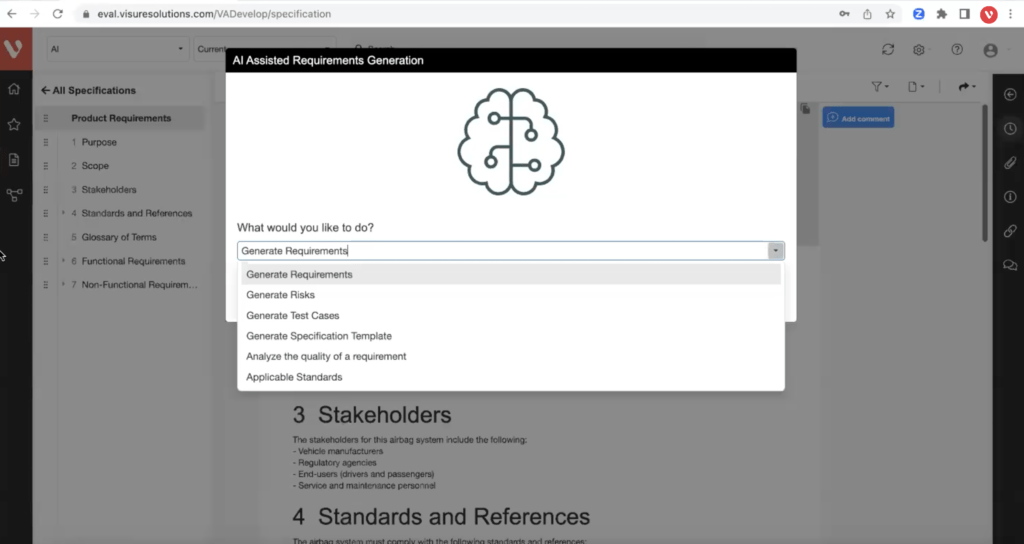
Learn how generative AI and machine learning automate requirements gathering, quality analysis, risk assessment, and traceability matrix generation to accelerate development timelines.
- Webinar
AI-Powered Verification & Validation: Achieving End-to-End Traceability and Faster Certification
Watch how AI-driven verification and automated test generation enable continuous compliance monitoring, seamless change impact analysis, and up to 50% faster certification workflows.
- Guide
AI Requirements Verification and Validation: A Complete Guide
Learn how AI transforms verification and validation processes by automatically detecting ambiguous wording, validating acceptance criteria, and building audit-ready compliance evidence.
See AI-Driven Requirements Management & Traceability in Action
Connect your existing engineering workflows to AI agents that accelerate requirements traceability and strengthen certification evidence — start a free trial or watch a live demo of it in action.
FAQ
AI-Driven Requirements Management FAQs
Can’t find an answer? Contact our team →
AI automates manual tasks like requirements elicitation, analysis, and traceability. Using Natural Language Processing (NLP) and Machine Learning, AI algorithms identify inconsistencies, extract key requirements from unstructured data, and link project artifacts, significantly improving productivity, accuracy, and overall development speed.
Yes. AI automates compliance checks against standards like DO-178C or ISO 26262, performs automated risk assessments, and maintains full end-to-end traceability. However, AI serves as an efficiency-boosting tool to complement, not replace, human expertise and final regulatory oversight.
AI analyzes written requirements to automatically generate structured test cases, prioritize high-risk scenarios, and perform continuous quality checks. This ensures maximum test coverage, reduces manual scripting effort, and catches ambiguities or errors early in the development lifecycle.
AI can struggle with complex domain-specific context, ambiguous requirements, and out-of-the-box creative problem-solving. Its outputs depend heavily on training data quality, making human oversight essential for interpreting nuances, preventing bias, and guiding final strategic decisions.