- Visure X
AI Engineering Management
for Multidisciplinary Product Development
From requirements to market release, Visure X connects every discipline in one AI Engineering Platform that runs 50x faster.
- Most cost-effective
- Access All Features
- 14-Day Trial
The Challenge
Multidisciplinary Teams Are Still Working in Silos
Siloed Disciplines & Tools
Ungrounded AI Output
No Auditability
Late Compliance Risk
Costly Rework
Slow at Scale
Engineering Management
One Engineering Context Across Every Discipline
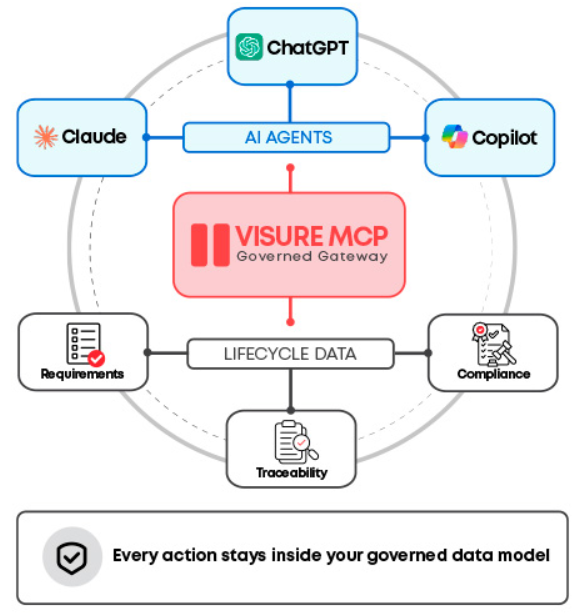
- Spec-Driven Development. Engineers and AI agents build from the same approved specifications through MCP, so every generated artifact starts from governed requirements.
- AI-Driven Development. AI drafts, reviews and links requirements, tests and risks across disciplines, and an engineer approves every change.
- End-to-End Traceability. Bidirectional links from requirements to models, code and tests stay current as each discipline makes changes.
- Tools Stay Where They Are. MBSE models, test results and source code remain in their own systems while data flows between them in real time.
- Compliance & Governance. Approvals, e-signatures and audit trails apply to every action, human or AI.
Workflows
Visure X Features, Organized by Workflow
Built from your requests. Eight engineering workflows, each running inside one governed data model. Look for NEW to see what changed.
01 · AI Requirements Authoring & Decomposition
Stop retyping the same information into five different documents.
- Requirements Decomposition, Concept to Subsystem. Describe a feature in natural language and AI breaks it into a full hierarchy, stakeholder to subsystem, linked at every level.
- AI Import from PDF, Word, Excel & ReqIF. AI reads legacy specifications and turns them into structured requirements with IDs and attributes.
- Richer Attributes. HTML, Diagram and Calculated attribute types, with global parameters detected automatically across documents.
- Simpler Interface. Switch between Document, List, Kanban and Traceability views, and save custom views for your team.
02 · Requirements Quality & Review
Stop discovering requirement gaps during the audit.
- AI Quality Analysis. INCOSE and EARS checks on every requirement, with the reason for each issue and a suggested rewrite.
- AI Project Analysis. Claim extraction finds contradictions, duplicates and verification gaps across documents.
- Improved Reviews. Role-based reviews with approve, rework and reject results tracked in real time, plus @mentions and comments.
03 · Traceability & Impact Analysis
Stop losing time rebuilding trace matrices by hand.
- Selective Suspicion Triggers. Choose which attribute changes mark a link as suspect, so engineers review real impact instead of noise.
- Impact Analysis Views. See every downstream requirement, design item and test affected before a change is committed.
- AI Traceability Review & Coverage Dashboard. AI finds untraced items and recommends links, while rule-based coverage is tracked per document with matrix export to Excel.
04 · Test, Risk & Verification
Stop writing test cases from scratch for every requirement.
- AI Test Case & Risk Generation. Draft test cases and risk cases directly from requirements, linked back automatically.
- Step-by-Step Test Execution. Record results per step and raise defects from failed steps, traced from discovery to resolution.
- Risk Management. Failure modes, effects and S / O / D ratings linked to the requirements and tests that cover them.
05 · Toolchain Orchestration & Automation
Stop manually re-entering the same change across five tools.
- Graphical Automations. A node-based Automation Designer with events, attribute read and write, JS blocks and step-by-step test runs.
- Event-Triggered Workflows. For example, a new issue automatically generates the matching requirements and risk cases.
- More Integrations via API & MCP. Connect Claude, ChatGPT, Copilot, Jira, Azure DevOps, Enterprise Architect and Fusion Manage, including trace links from code in the IDE.
06 · MBSE: SysML & UML
Stop maintaining models and requirements in separate worlds.
- SysML Import by Package. Import SysML models package by package and keep every element as a traceable item.
- UML Diagrams. Design UML diagrams of elements and their relations directly in Visure X.
- Model-to-Requirement Traceability. Link blocks and functions to the requirements they satisfy, and see impact across both.
07 · Branching, Variants & Change Management
Stop copying whole projects to manage one variant.
- Branching & Merging. Create branches for parallel work and merge changes back with a visual create and merge history.
- Customer & Region Variants. Manage variants on branches and reuse documents and requirements across projects without duplicating content.
- Change Requests on a Kanban Board. Link every change request to the items it affects and move it through approval visually.
08 · Compliance & Audit Readiness
Stop scrambling to assemble audit evidence at the last minute.
- Baselines & E-Signatures. Snapshot any point in time, compare two baselines, and capture e-signatures on approvals.
- PDF, Word, HTML & ReqIF Export. Export documents and data in the format each stakeholder or supplier needs.
- Embedded Report Manager. Build report templates with page setup, cover, table of contents and sections, with a live preview.
Why Visure X
Visure X vs. Traditional Requirements Tools and Generic AI
| Category | Visure X | Requirements Management Tools | AI Tools |
|---|---|---|---|
| Speed at Scale | 50x faster, even on large projects | Slow down as projects grow | Fast, but disconnected from project data |
| Product Context for AI | AI grounded in your requirements, tests, risks and standards | No AI, or AI bolted on | Generic answers that can hallucinate |
| AI Governance | Permissions, human approval and a logged record of every AI action | Not designed for AI oversight | No approvals, no record of what AI changed |
| Cross-Discipline Traceability | Bidirectional links across requirements, MBSE, code and tests | Limited to the requirements silo | None |
| Integrations | 30+ native connectors across PLM, MBSE, test and DevOps | A few connectors, often via file export | Plugins for coding and office tools only |
| Orchestration | AI agents work across connected tools through MCP, inside one governed model | Point-to-point sync between tools | Works in one tool at a time, with no write-back control |
| Parallel Development | Branching, merging and variants | Projects copied by hand | Not applicable |
| Change Impact | Selective suspicion and impact views | Every change flags everything | None |
| Automation | Graphical, event-triggered workflows | Scripting required | Prompts with no process control |
| Audit & Compliance | Baselines, e-signatures, templates and a full audit trail | Supported, but heavily manual | No version history or approvals |
| Flexible Deployment & Licenses | Cloud, private cloud or on-premise, with licenses and AI usage managed in-app | Fixed deployment and long procurement cycles | Vendor cloud only, per-seat subscriptions |

INTEGRATIONS
Works With Your Existing Engineering Toolchain
Compliance & Governance
Built for Regulated Industries
Design & Engineering
- DORA
- ISO 27001
- SOX
Semiconductors
- ISO 26262
- IEC 61508
- CMMI
- DO-254
Industrial Manufacturing
- IEC 61508
- ISO 13849
- IEC 62443
Consumer Electronics
- CRA
- IEC 62443
- ISO 27001
Oil & Gas
- IEC 61511
- API RP 754
- IEC 61508
Deployment
Your Data Stays Yours
| Cloud (SaaS) | Private Cloud | On-Premise | |
|---|---|---|---|
| Hosted by | Visure | Your cloud account | Your servers |
| In-App AI Assistant | ✓ | ✓ | ✓ |
| External AI Agents via MCP | ✓ | ✓ | ✓ |
| LLM Options |
|
|
|
| What Leaves Your Environment | Managed by Visure | Only the LLM connection | Only the LLM connection, or nothing with a local LLM |
| Best For | Fast start | Enterprise IT standards | Defense and classified programs |
Visure X
Frequently Asked Questions
Can’t find an answer? Contact our team →
Visure X is an AI-native engineering management platform for multidisciplinary product development. It brings requirements, MBSE models, tests, risks and compliance evidence into one governed data model, so engineering teams and AI agents work from the same source of truth across mechanical, electrical, software and systems engineering.
Yes. Existing Visure Requirements ALM projects can be migrated to Visure X, including items, attributes, traceability links and baselines. Our team helps plan the migration so active programs keep their full history and audit trail.
Engineering management software coordinates the work that turns product intent into a released product: defining and allocating requirements, linking them to design, verification and risk, controlling change, and producing the evidence customers and regulators ask for. It gives program leads one view of status across every discipline instead of a separate report from each tool.
PLM (Product Lifecycle Management) manages the physical product: parts, bills of materials, CAD data and manufacturing changes. ALM (Application Lifecycle Management) manages the software lifecycle: code, builds, tests and releases. Engineering management sits across both, connecting the requirements, interfaces and verification evidence that tie hardware and software decisions to the same product intent. Most regulated teams use all three, with engineering management as the layer that keeps them consistent.
Start from one set of system requirements and allocate each one to the discipline responsible for it. Define interface requirements wherever two disciplines meet, such as a sensor's electrical signal and the software that reads it, because most integration failures happen at those boundaries. Keep each discipline's derived requirements linked to the shared baseline, so a change in one area immediately shows which teams it affects.
AI governance is the set of controls that decide how AI can be used on engineering data: which models are allowed, what data they can access, who approves AI-generated content, and how every AI action is recorded. It matters because regulators increasingly expect it. Frameworks such as the EU AI Act emphasize human oversight and record-keeping, and aviation and medical device regulators have published guidance on AI. Without governance, AI-generated requirements are hard to defend in an audit.
Yes, as long as AI output is treated like any other engineering input. DO-178C and ISO 26262 don't prohibit AI-assisted authoring, but every requirement, test or analysis it produces must still be reviewed, verified and traced like human-written work. If AI output is used without that verification, the tool may need qualification, for example under DO-330 for airborne software or a tool confidence level assessment under ISO 26262 Part 8. That is why human approval of AI content matters in regulated programs.
The Model Context Protocol is an open standard that lets AI assistants connect to external tools and data through a common interface. Instead of building a custom integration for every AI model, a system exposes one MCP server, and any compatible assistant, such as Claude, ChatGPT or Copilot, can use it within the permissions that system allows.
Explore More
Related Resources
Product Sheet
Webinar Recording
Get Started
Ready to See VisureX in Action?
Start a free trial with access to every feature and guided onboarding and experience VisureX on your own multidisciplinary projects.
- Invite your team across all disciplines
- Import your own project data
- Experience the power of Engineering Intelligence
- Explore Industry-specific compliance sets
- Onboard with ease
Get Started with VisureX
By submitting you agree to Visure’s Privacy Policy.
- 14-Day Trial
- Cancel Anytime
- All Features Included