
- Whitepaper
The Comprehensive Handbook on FMEA Risk Management
Walk away with a systematic framework to identify failure modes, enforce full compliance, and mitigate critical hazards across product lifecycles.

Talk to Our CRA Compliance Team
What You'll Learn
What is FMEA Risk Management, and why it's important?
Master practical strategies to streamline risk assessment and enhance product reliability in regulated engineering environments.
- Master fundamental FMEA frameworks to systematically identify, evaluate, and mitigate potential failure modes.
- Implement step-by-step techniques for compliant risk assessment, tracking, and documentation across lifecycles.
- Connect FMEA directly to requirements engineering and modern tools to eliminate rework.
Explore More
Explore Related Resources
- Article
FMEA Risk Matrix: How to Assess Risk Using FMEA
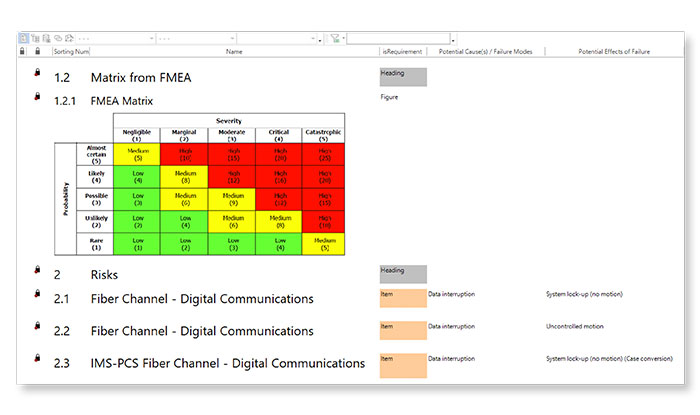
Explores the fundamental concepts of Severity, Occurrence, and Detection within the FMEA Risk Matrix to prioritize hazards effectively.
- Webinar
AI-Powered Verification & Validation: Achieving End-to-End Traceability and Faster Certification
Learn how to automate verification tasks, ensure full traceability, and streamline compliance and risk validation using AI-driven ALM workflows.
- Guide
Complete FMEA Guide in MedTech & Pharma
A step-by-step industry guide covering DFMEA, PFMEA, ISO 14971 compliance, and root cause analysis in regulated safety-critical environments.
Eliminate FMEA Compliance Bottlenecks in Your Lifecycle
See how integrating FMEA with automated requirements management accelerates audit readiness and reduces time to market. Start your free trial today — start a free trial or watch a live demo of it in action.
FAQ
FMEA Risk Management Handbook FAQs
Can’t find an answer? Contact our team →
FMEA is a structured risk assessment methodology used to proactively identify, evaluate, and mitigate potential failure modes in product designs, manufacturing processes, or systems to ensure safety and regulatory compliance.
Design FMEA (DFMEA) focuses on eliminating design-related failure modes before production, while Process FMEA (PFMEA) targets risks within manufacturing workflows, assembly, and operational procedures to prevent defects.
The Risk Priority Number (RPN) quantifies and prioritizes risk severity. It is calculated by multiplying Severity (S), Occurrence (O), and Detection (D) ratings (RPN = S x O x D).
FMEA aligns with standards like ISO 14971 and ISO 26262 by systematically identifying critical hazards, establishing control measures, and tracking risk mitigation to maintain continuous audit readiness.